
Showing posts with label Chapters mind maping. Show all posts
Showing posts with label Chapters mind maping. Show all posts
Wednesday, November 24, 2010

ch 20 Proposing a Solution

Proposals are prescription for change. As such, they challenge readers to care about broblem, accept a solution, and act on it. A strong proposal offers a logical, practical, and creative argument that leads toward positive change, whether it's defending against terrorism, requiring both men and women to register for the military draft, or adding to the debate on cloning.

Sunday, November 7, 2010
ch 18 Taking a Position

ch 17 Strategies for Argumentation and Persuasion

This chapter is a resource on reasoning. It explains the foundation of argumentation and persuasion and introduces three related forms - taking a position, persuading readers to act, and proposing a solution.
ch 16 Definition

Saturday, October 23, 2010
ch.15 Process writing

ch.14 Classification

Friday, October 1, 2010
Ch.13 Comparison and Contrast

Saturday, September 25, 2010
ch.12 Cause and Effect

We ask "Why" to understand and cope with things that happen in our lives. Knowing what causes a diseas such a diabets - or knowing its effects - helps to understand and control the condition. In other words, cause and effect reasoning helps as deal everyday issues.
Tuesday, September 14, 2010
ch.11 DESCRIPTION AND REFLECTION.
A personal reflection is often written to draw wisdom from past experiences. In the process, you will likely gain insight not only your past experience, but also into its links to your present and future.


ch.10 NARRATION AND DESCRIPTION.
At with all forms of writing, you should develop your personal essays using whateverstrategies fit your writing situation: your subject, audience, and purpose. A personal narrative is a story - a story that mirrors you and experiences. In it, you may tell about a time when you were afraid, lost something, found joy, learned a tough lesson, or discovered some secret.


ch.9 FORMS OF COLLEGE WRITING
You have to learn course content and to learn how to carry on a written dialogue with others in your field. The chapter presents more specific information about academic depertments, including the topics student study, the forms of writing teachers assign, and the traits of those forms.


ch.8 WRITING PROCESS
An essay is an attempt to understand a topic more deeply and clearly. The best advice is take matters one step at the a time, from understanding the assignment to submitting the final draft.


ch.7 Submitting writing and creating portfolios
Submitting a final paper is the driving force behind writing. Often, the most immediate and important form of submitting is sharing a finished piece of writing with your instructor and writing peers.


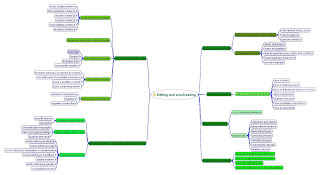
ch.6 Editing and proofreading.
These comes a point in any writing project when you must prepare your writing for submission. At that time you must edit and proofread your revised writing so that it speaks clearly and accurately. When you edit, look first for words, phrases, and sentences that sound awkward, uninteresting, or unclear. When you proofread, chek your writing for spelling, mechanics, usage, and grammar errors.

ch.5 REVISING
Revising takes courage. Good writing almost always requires revising and, in some cases, subtantial, rework. During this step in the writing process, you make changes in the content of your firs draft until it says exactly what you mean.


ch.4 Drafting
The first draft is not the one that will distinguish you as a writer. It's a way of getting material together, starting out, connecting your ideas. A first draft gives you something to work with - verbal wet clay - that will later, through revising and editing, result in a polished piece of writing.


ch.3 Planning
Planning of almost any type requires careful thinking.You have to establish a thesis or focus for your writing, and organize the supporting information. You will need to indentify the method of development - comparison, cause/effect, classification - the best supports your thesis, and then organize your details accordingly.


ch.2 Writing process
You encourage to think and figure things out for yourself. Once you understand the writing process - from forming a clear sense of the assignment to submitting the final draft - you will be able ti produce essays and papers that reflect your best thinking.


ch.1 CRITICAL THINKING
When you think critically, you examine ideas fully and logically, weigh multiple perspectives on issues, and draw reasonable conclusions. In the process, you carry on an in-depth dialogue with information and evidence. And your training in critical thinking prepares you for work in your profession and in the public square. Thoughtful reading and viewing, then, lie at the heart of critical thinking and feed into thoughtful writing.

Subscribe to:
Posts (Atom)